
At around 4:30am on 25 April 1915, soldiers of the Australian Imperial Force began landing at what is now called Anzac Cove on the Gallipoli Peninsula. For the vast majority of the 16,000 Australians and New Zealanders who landed that day, it was their first experience of combat. By that evening, 2,000 of them had been killed or wounded.
Amongst those who managed to survive the chaos that unravelled around him was Fremantle resident and Claremont attacker Elgar Hale. The 27-year old was one of an estimated 500 players, officials and administrators of the round ball game in Western Australia to answer ‘the call of the Empire’ by serving in the all-volunteer AIF.
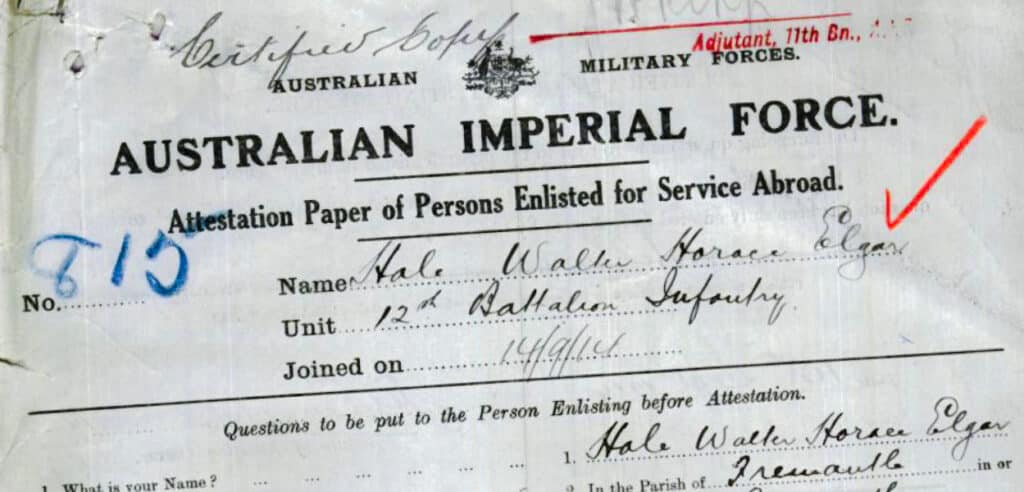
Walter Horace Elgar Hale was born in April 1888 in Fremantle. One of nine children to William, a carpenter with the railways, and his wife Mary, Elgar grew up in the family home on Attfield Street in South Fremantle. The Hale family were active in their local community, particularly when it came to nearby St Paul’s Anglican Church where the Gymnasium Club provided a social and sporting hub for their children.
Elgar commenced his education at Beaconsfield Primary School and at the age of 14 graduated from Fremantle Boys School. He then entered the workforce as an ironmonger with J&W Bateman, a prominent merchant and importer operating in Fremantle’s west end. It’s likely he remained in the employ of the same firm well into his 20s when he worked as a commercial traveler, a position better known today as a sales representative.
Displaying an natural affinity for sport, Elgar had by this time gravitated towards Gymnasium Club, where he excelled at long distance running and swimming. Following his in parents’ footsteps, he took an active role in the club and rose to the dual position of vice-captain and delegate to the Gymnastic Association. Elgar also established a reputation as a proficient chorister, eventually joining the St George’s Cathedral choir in central Perth.
Football in Western Australia was beginning to boom and it’s likely the Hale who stepped onto the field in 1904 with the Fremantle Reserves junior league club was a 16-year old Elgar. Four years later he and teammate Gregg moved to the emerging Claremont club, who fielded teams in all three divisions under the WA British Football Association. Also playing by this time were his younger brothers Vernon and Cyril, for third tier Fremantle Albion (formerly Fremantle Reserves).
As part of the attacking line for Claremont No.1 – the clubs ‘B’ team – Elgar found the back of the net with regularity during a debut season highlighted by a late winter hat-trick in a 5-0 thrashing of Ex-Students. The Reds won the Junior Challenge Cup final, defeating North Perth Rangers 1-0, but the result didn’t stand owing to a fight which broke out between two Rangers players and the referee. Rangers would claim the following week’s replay 2-1.
The Hale household would have been rocked in March 1910 when family matriarch Mary passed away “after a very long illness”. It came almost three years to the day after Elgar felt dearly the loss of his sister Edith, who was four year his elder. It was the third time in his 22 years that Elgar had experienced death, although he would have had little memory of brother Matthew’s passing in 1890.
The 1910 and 1911 league seasons were dominated by Claremont No.1, who collected back-to-back Division Two titles by pilling on a cumulative total of 89 goals across 28 home and away games. And they became just the third team from outside the top flight to lift the prestigious Charity Cup by defeating Training College 1-0 in the 1911 final. During this period Elgar gained selection in a Division Two representative team that met their Division One counterparts in a friendly.
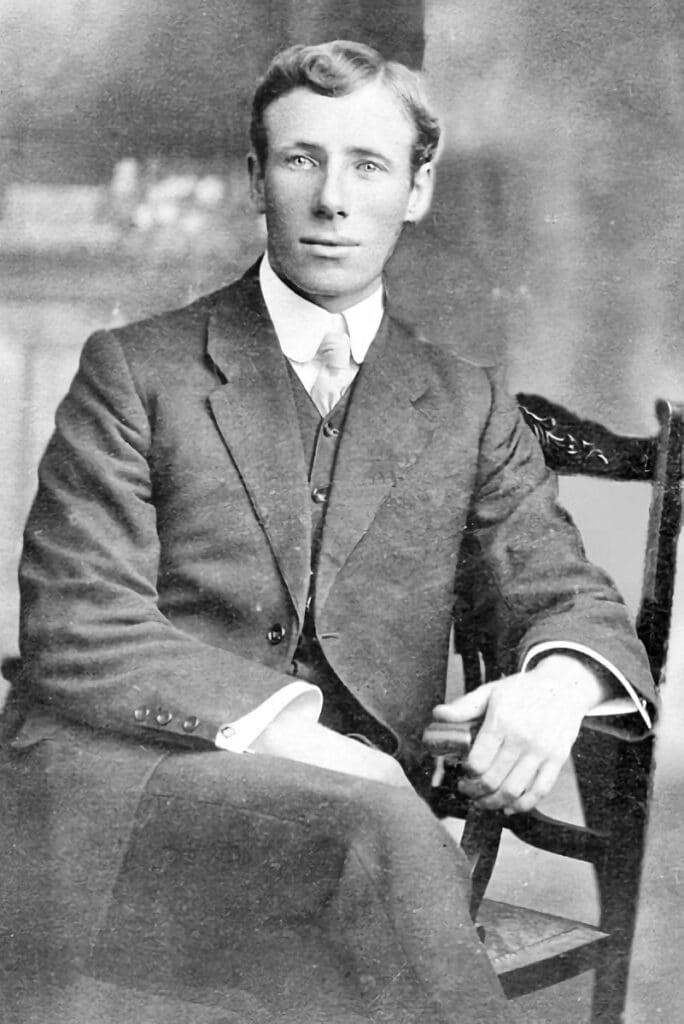
Elgar was a regular member of the team, known as Claremont Glebe from 1911, that placed second in Division Two three seasons in a row as well as in the 1912 Challenge Cup final, where they were pipped 2-0 by Claremont’s ‘A’ team. He helped Glebe finish top of Division Two for a third time 1914, edging out Rangers United by a single point but missed the end-of-season Challenge Cup final, a loss to Thistle.
Australian Prime Minister Joseph Cook announced the nation’s entry into World War 1 in the early hours of 5 August 1914. 26 days later Elgar enlisted as a Private in the 12th Battalion, which was drawn largely from Tasmania with around half comprised of South and Western Australians. On completion of basic training at Blackboy Hill Camp, he boarded the HMAT Medic in Fremantle Harbour bound for Egypt, where further training awaited.
Elgar’s unit were selected to be one of the first ashore at Gallipoli in the pre-dawn of Sunday April 25 1915. Many men from the 12th Battalion were killed and wounded during the landing and the hours that followed but Elgar, who had recently been promoted to Corporal, survived unscathed and was mentioned in the 12th Battalion history for his courage and leadership on that fateful day.
Little over a week later Elgar was incorrectly reported to have been severely wounded and evacuated to a hospital ship, where he died of wounds. The distressing news reached his family in Fremantle and a memorial service was held at St. Paul’s Church. Sometime later ‘the Western Mail’ newspaper reported “his relatives received a private cable to the effect that he was alive and well. As the result of further inquiries made by the military authorities, it has now been ascertained that he has been wounded, and is in hospital at Alexandria, doing well.”
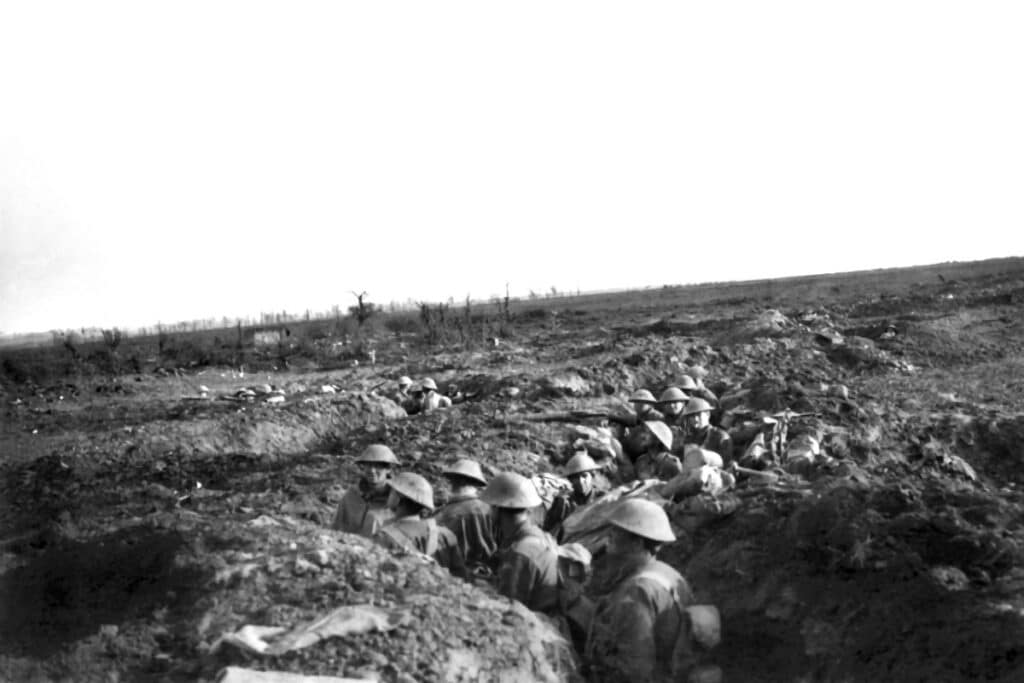
Elgar had been hospitalised with bronchitis but was soon back on the Gallipoli Peninsula where fighting had settled into trench warfare. The 12th Battalion were involved in trying to improve the trench system in anticipation of an enemy attack, which arrived on 19 May and was repelled with the Turkish suffering heavy casualties. Elgar wrote a letter home on the day of that attack –
“I am in the trench writing this and got a smack just below the ankle of the left foot with a bit of stray shrapnel. It has only made a small bruise, my boot being a good protection. The shot and shell has been literally screaming over since very early this morning and is still going good… Although the Turks have reported in their papers that they drove the Australians into the sea we are still on their little bit of “Terra Firma” and intend stopping there until we have settled the job we came for. The only driving into the sea we have had so far is when we want a wash.”
Elgar was promoted to Sergeant at the start of July. The following month the 12th Battalion were called upon to help retain the captured trenches at Lone Pine. “I suppose you have read about us taking three rows of Turkish trenches last August 6th. They kept a terrible lot of dead lying in the trenches and we had to walk over them all night and about on them. It is better though than having them standing on one’s self. Isn’t it?,” he wrote.
“The beggars nearly got me with a bomb. I had quite a nice job. Chasing bombs as they landed in the trench and dropping a bag of sand on them, so as to localise their explosion. I saw one coming through the air and was bending down picking up the bag to drop on it; but it exploded just behind my back and knocked me over… All I know is that I struggled out with my eyes and mouth full of sand and my ears buzzing and very deaf.”
The close call had left Elgar suffering concussion and he spent the next few weeks hospitalised in Alexandria, Egypt. On returning to active duty he rotated in and out of the line before the 12th Battalion were sent to Lemnos to rest and recuperate. It was while on the Greek island that the order came through for the evacuation of the Gallipoli Peninsula towards the end of the year. But before that happened, Elgar was made Company Quarter Master Sergeant.
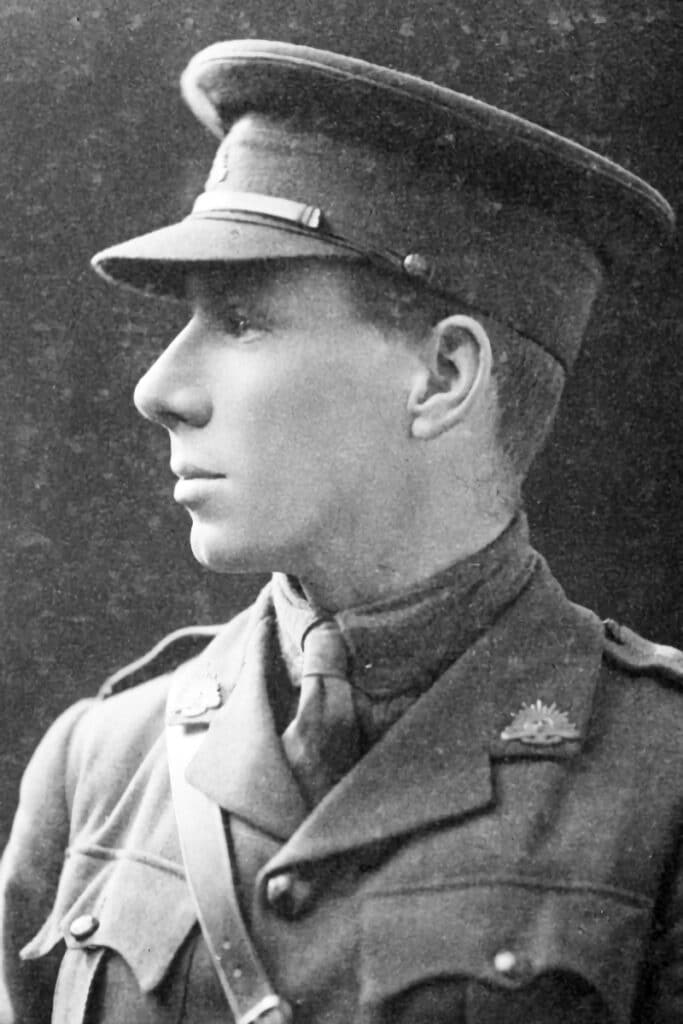
The 12th Battalion arrived back in Egypt at the start of January 1916 and took up residence at Tel El Kebir. An expansion and reorganisation of the Australian Imperial Force in February saw Elgar promoted again, this time to Company Sergeant Major. It was while passing the time in Egypt’s deserts that Elgar penned a letter home to his nearest sibling, Beatrice –
“Here I am again bobbing up in all kinds of places. At present the sand is blowing in clouds all over the desert and the wind which is doing the lifting of the sand is bitterly cold… My word Beat I only wish I was in that fortunate position to have an aeroplane. I can assure you that I would make a direct flight for the little grey home in the West. I never like to hear that dear old Father is looking unwell. I do hope and trust that he will not be doing too much hard work, for I think the dear old soul is getting a wee bit old now. When I get back please tell him I want to see him looking in very good health. It would really worry me if I thought he was ill at all.”
Soon after arriving in France in March the 12th Battalion entered the front line at Armentieres, a quieter part of the Western Front where they gained valuable trench warfare experience. Three months later they saw their first major action when engaged by the German army at Pozieres and Mouquet Farm in the Somme Valley.
“Yesterday I sent a cable to let you know that I came through our big fight without a scratch. No two ways about it, we have gone through the roughest and hardest fight possible to go through. The strain was awful for us all; but I think I am feeling just the same old kid once more now, although during last Monday and Tuesday I would have sold my chance of coming out alive for 6d., and consider I was getting a good price for it… we captured the village of Pozieres. My company was the first to get right through Pozieres, and we held on like grim death. When we Australians made our attack many thought we couldn’t take this village (but) we swept them off their feet and captured three rows of trenches and right through the village in eighteen hours. On two or three previous occasions the English troops had tried to take this place, and failed, so you can guess what a feather in our caps it is to capture this place, which was considered by the Germans to be impregnable…
We all got a couple of Hun helmets each, but they were nearly all blown to pieces by the terrific bombardment which we had to go through. During this awful bombardment, which lasted 24 hours, we that came out alive had most miraculous escapes. Dozens upon dozens of rifles fell into our hands, and I believe our troops for miles along the line met with equal success. I have a Prussian helmet, badge and belt buckle, which I will send home for safe keeping this week some time. As we swept through the village on Monday evening the remaining portion of the enemy (other than those who surrendered) absolutely flew in all directions to get away. One man I saw got away on a bicycle along the road, and about a dozen flew off in different directions, and those on foot dropped their rifles, and I am sure they never stopped until they reached Berlin. Those taken prisoners seemed pleased to be captured.
The place was covered with dead Huns, horses, and a team of oxen, and the stench was awful after a day or so. A large hospital van with six men and the driver inside was just behind where we made our trenches. They were all dead, also the horses, and, by strike, it was eau-de-Cologne with a vengeance. The trenches we took before reaching the village were filled almost to the top with dead Huns, and we had to walk over them. Our losses, although heavy, were nothing in comparison to the enemy’s. On Tuesday morning they launched a counter-attack against us. I happened to be observing at the very moment the first line of attack appeared over the ridge in front. We were well prepared for them, but they never got closer than 100 yards, for our artillery, machine gun and rifle fire wiped them almost out of existence. Three rows of the enemy came over, but they each fared the same. The massacre was awful to see. I can’t for the life of me see how the enemy can keep going losing troops like the way they are.”
The 12th Battalion were eventually withdrawn and sent to rest in a quieter part of the line in the Ypres Sector, Belgium, where Elgar was promoted to Lieutenant. Transferred back to the Somme in October, Elgar was struck by shrapnel just above the left clavicle and through the neck three days before Christmas. He had bullet fragments removed while at the 38th Casualty Clearing Station before being evacuated to England for what would be a two-month hospital stay at Wandsworth, followed by convalescence at Perham Downs.
By this time Elgar’s brothers Vernon and Cyril had enlisted. Vernon had been deployed to the battlefields of France with the 8th Field Artillery Brigade while Cyril was about to commence training with the 11th Battalion at Durrington Camp in England. Elgar rejoined his unit in May 1917 and later that month all three brothers were resting out of line when they met up for what would be the final time. Vernon described the scene in a letter home to a sister –
“I have some great news for you this mail, news which I have been waiting to write of for a long time and that is the meeting of we three boys. Yes! Last Saturday was the beautiful day on which I met Bosun & Squib. Can you imagine how delighted & pleased such a trio would be. Last Saturday I got news that the 11th & 12th were at a neighbouring village and of course next day I set out to find them. It was awfully wet and moreover I rode a bicycle. Curiously enough as I learnt afterwards, who should arrive at our camp looking for me some twenty minutes after my departure, but Elgar. Ha-ha. He was riding a bicycle too I believe and just about wet through. However my ride was much further than I anticipated. In fact I went quite a roundabout way following the directions of other 1st Div chaps.
Anyway after about three hours I landed quite excitedly in a little village and made enquiries for Elgar’s billet and in a typical old French farmhouse I met him. He was having dinner and this child received quite a cordial reception (& a jolly fine dinner) in the Officers Mess. They were a fine happy crowd of chaps and with very few exceptions original members of the Battalion. Of course Elgar and I could not talk quickly enough and what was more we had to find young Cyril. Another ride of about ten minutes took us to the vicinity of dear old Squib’s billets. I was riding a little ahead of Elgar and strolling some distance ahead were two of the lads of the 11th. One I instantly recognised as Squib, so I rode up and hopping off I said “Hello Squib”. Strike he nearly fell over with surprise.
Can you picture we three boys meeting after such a long time. I think we were too excitable to discuss things much. They are both in splendid condition. Elgar is just about as well as I am and has a splendid athletic build. Although outwardly he is thoroughly happy and contented I reckon he’s a well bit homesick. Of course his men can’t be beaten in his estimation and what is more he looks after them. Young Squib is well formed & inches taller than either of us two. He has not got any fatter but looks extremely well and fit and what is more he seems quite contented. We only had a few minutes together, but they were happy ones and if all goes well I hope to see them again soon.”
The 12th Battalion didn’t returned to the front line until in September and were heavily involved in the capture of German positions along Menin Road at Glencourse Wood, Nonne Boschen and Polygon Wood. Unfortunately, Elgar’s luck ran out on the evening of 5 October 1917 when he and Corporals Hamilton and Henderson were killed by a bomb explosion while crossing a duckboard track at Broodseinde Ridge, Ypres, Belgium. Private Cowderoy of the 12th Battalion witnessed Elgar’s death –
“He was up in the trench leading a party over when he was struck by a shell and wounded in the breast; and he died a few hours later. I saw this myself and helped to bury him 300 yards on the other side of Zonnebeke Gasometer. We went out of the line. On November 3rd we took a cross up and the Adjutant & Intelligence Officer were there. When we arrived at the grave we found that the body had been blown out and also those of two soldiers. The two officers and the party buried all three again and put up a cross for Lt Hale and the two soldiers.”
It’s not known if Cyril learned of Elgar’s death before he was badly wounded himself three days later. Evacuated to England and admitted to Bethnal Green Military Hospital, Cyril had suffered gun shot wounds to the left leg and left arm plus a compound fracture of the left tibia. He was to spend several months recovering in England and was eventually repatriated to Australia in March 1918.
Vernon, too, was in a bad way. In September, he had been sleeping in a dugout near Menin Road when it was blown in by a German shell. Buried underneath the rubble, he was saved from suffocating by colleagues but his injuries were great, the most serious being a curvature of the spine. He was sent to England in June and by October was on his way home to Fremantle.
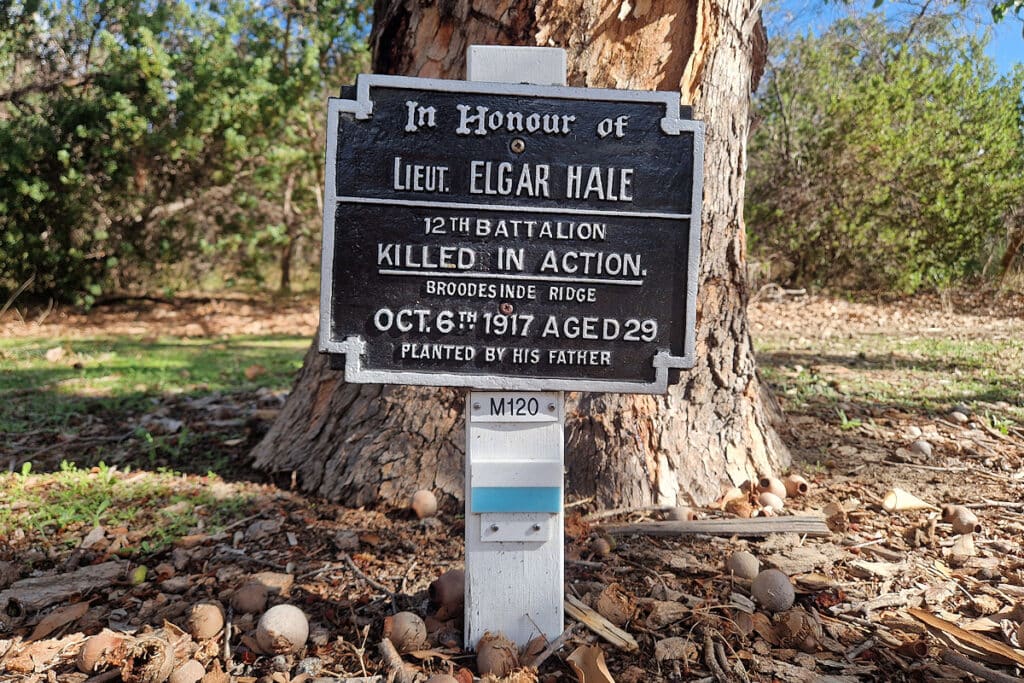
The memory of Elgar lived on long after his death. In 1919 his father, William, commissioned an Honour Avenues plaque in his memory in Kings Park, Perth. Around this time the family received a Memorial Scroll and Plaque followed by Elgar’s AIF service medals. His original burial place was exhumed and his remains moved to Tyne Cot Cemetery in Belgium, where he rests to this day surrounded by his brothers in arms.
Elgar is one of a dozen choristers whose lives were lost in the Great War that are featured on a remembrance plaque unveiled at St George’s Cathedral on ANZAC Day 1951. About five years later the City of Fremantle renamed Healy Road to Hale Road in honour of the athletic achievements of Elgar and Vernon. And in more recent times the brothers were recognised by Beaconsfield Primary School, where Gold faction is also known as Hale.