
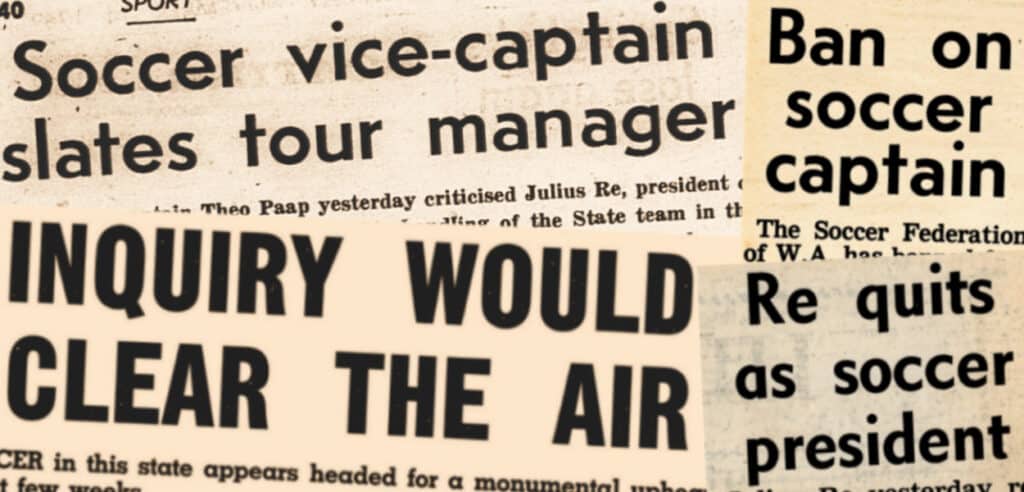

Few moments in Western Australian football history created as much controversy and division as the bitter dispute between Soccer Federation of WA president Julius Re and State team captain John O’Connell following the Merdeka Tournament in 1969.
The State team’s participation in the Malaysian tournament was intended to build on two years of growing success on the international stage. But instead it sparked a clash of personalities and a bitter war of words that played out all too publicly in Perth’s daily newspapers.
What began as a disagreement over team management rapidly escalated into a series of accusations and counter-claims, a hastily arranged Federation inquiry and subsequent appeals which ended with O’Connell being banned from the State team for five-years and the resignation of Re as Federation president.
In October 1969, Western Australia embarked on a four-week tour of Southeast Asia to compete at the prestigious Merdeka Tournament in Kuala Lumpur followed by the King’s Cup in Bangkok. State coach Jim McDowall assembled a 17-player squad for the trip, which was Western Australia’s third in as many years.
The tour took place against a dramatic backdrop. The Merdeka Tournament, traditionally held in August as part of Malaysia’s Independence Day celebrations, had been postponed following the deadly race riots that swept Kuala Lumpur following the general election in May. The violence claimed hundreds of lives and prompted a state of emergency and the suspension of Parliament.
The unrest had subsided by October, leading the government to use the tournament as a tool for national unity. Prime Minister Tunku Abdul Rahman, who was also president of the Football Association of Malaysia, believed football could help heal racial and political divisions, and demonstrate that stability had returned to his nation.
Nonetheless, for the eight competing nations, security remained a very real concern. “When we arrived in Kuala Lumpur I told the players that there would be no sightseeing tours and that a curfew would be in force till after our first match,” Re, who travelled to Malaysia as Western Australia’s tour manager, later explained.
“I was worried about the situation in Kuala Lumpur after the riots and so I had decided that the team would go everywhere together as a group as a safety precaution. Things are much different in Malaysia to what they were last year … We went to Asia to play soccer and for no other reason.”
The State team were confident of success at their third Merdeka appearance. The State team had placed ninth on debut in 1967 and twelve months later used that experienced to propel them to third with a minor place play-off win over Indonesia.
“With a bit of luck last year we could have won the competition,” Morley Windmills midfielder O’Connell told the West Australian prior to departing for Malaysia. “With two years experience behind us we must be considered one of the favourites this time.”
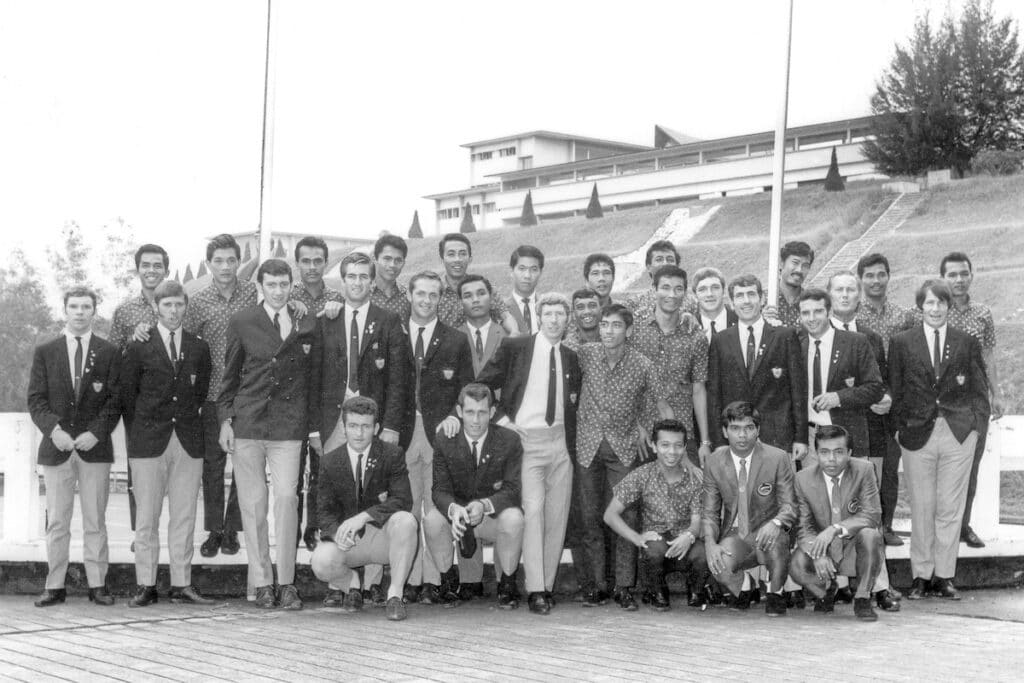
The State team’s campaign got off to a dream start with a rare Theo Paap goal securing victory over India. But back-to-back losses to Singapore and Burma sent them crashing to the bottom of qualifying Group Two. And there was further disappointment when Western Australia surrendered 2-3 to South Korea in the play-off for fifth.
With the tournament over, Paap returned to Perth. A few days later the Windmills defender made it clear where he felt the blame should lie for the teams’ flat performance in an explosive piece published by the West Australian under the headline ‘Soccer Vice-Captain Slates Tour Manager’.
“Mr Re was team manager this year but we rarely saw him,” Paap commented. “He left us to our own devices, without a schedule of daily activities and with a big list of don’ts. To be fair to him, he may have had other commitments in his position as federation president. Nevertheless, he failed to give any encouragement to the players and this was disappointing and demoralising.”
In further blow to morale, the State team had to borrow leather balls from rival teams to train with after the four plastic balls supplied by Re wore out. “Before I left to return home, the boys were considering pooling some money to buy some leather balls for the remainder of the tour,” Paap added.
By the time Paap’s criticism reached the newspapers, O’Connell had become embroiled in an even larger controversy. Stripped of the captaincy following the Merdeka Tournament, he travelled with the squad to Thailand for the King’s Cup. But following the opening match against South Vietnam, O’Connell was ordered home.
O’Connell had been found guilty of breaking team rules by being absent from his hotel room overnight and missing a scheduled training session on the morning of the South Vietnam match. Expelled from camp by Re, he made his way back to Perth via a two-day stopover in Singapore.
On arriving back in Perth, O’Connell intensified the attack on Re and in the most public of ways. “I would like to confront WA manager Julius Re and coach Jim McDowell at an open enquiry into the team’s condition while in Malaysia and Thailand,” O’Connell told the Daily News.
“I have seen the charges made by vice-captain Theo Paap when he returned to Perth more than a week ago and I fully agree with them. I’m quite certain that all the other WA players will also agree that our training conditions were poor and that two of the officials in charge were at times unreasonable in exercising their authority.”
“We were the only team in the Merdeka tournament who did not participate regularly in ball work during training. As spokesman for the players, I asked for leather balls to be provided, but this request was refused. Instead we were given plastic balls which proved inefficient.”
“All the players were baffled by the continuing changes in tactics made by McDowell as team coach during the Merdeka Tournament. There was no set formation the boys could settle down to. Instead we were told to use varying tactics in different matches and this was unsettling.”
“I’m also certain that because I was the players’ spokesman for various complaints, I became a target for retaliation. I was told it had been decided to send me home early, only an hour before the aircraft was to leave Bangkok on Friday morning. At no time did Mr Re or Mr McDowell talk to me beforehand about my conduct.”
O’Connell went on to claim invitations to attend social events outside of football were declined by team management and that players were confined to hotel rooms for lengthy periods, leading to boredom and a steady deterioration in team morale. “We were like caged lions,” he stated.
The situation unfortunately festered until Re landed at Perth Airport on November 30. The Federation president defended the decisions made while on tour, citing security concerns in Malaysia and lashed out at O’Connell’s constant negativity and breaching of team rules.
“The tactics were worked out by McDowell in co-operation with former Polish international Paul Sobek, who has been on the international scene a long time,” Re told the West Australia. “Yet O’Connell ridiculed his ideas in front of the rest of the team. With 11 of the 17 players making their first trip to Malaysia, this was bad for discipline and morale.”
“After the first game against India, which we won 3–1, some of the restrictions were lifted and the players were allowed to attend movies, go shopping and swimming, play golf and bowls and take part in other forms of recreation.”
“Despite repeated warnings about moving without the whole team, O’Connell, Paap and some of the other players went to a party after having attended one of the Merdeka games as spectators. They missed the bus back to the hotel, got home late and in the morning they were each fined $3.”
“On the night before our first game in Bangkok, O’Connell was missing from his room. He did not report back to the hotel till 8.45 the next morning and missed training. He was then told he would be sent home. Even then he failed to travel back to Perth according to instructions and stayed two days in Singapore.”
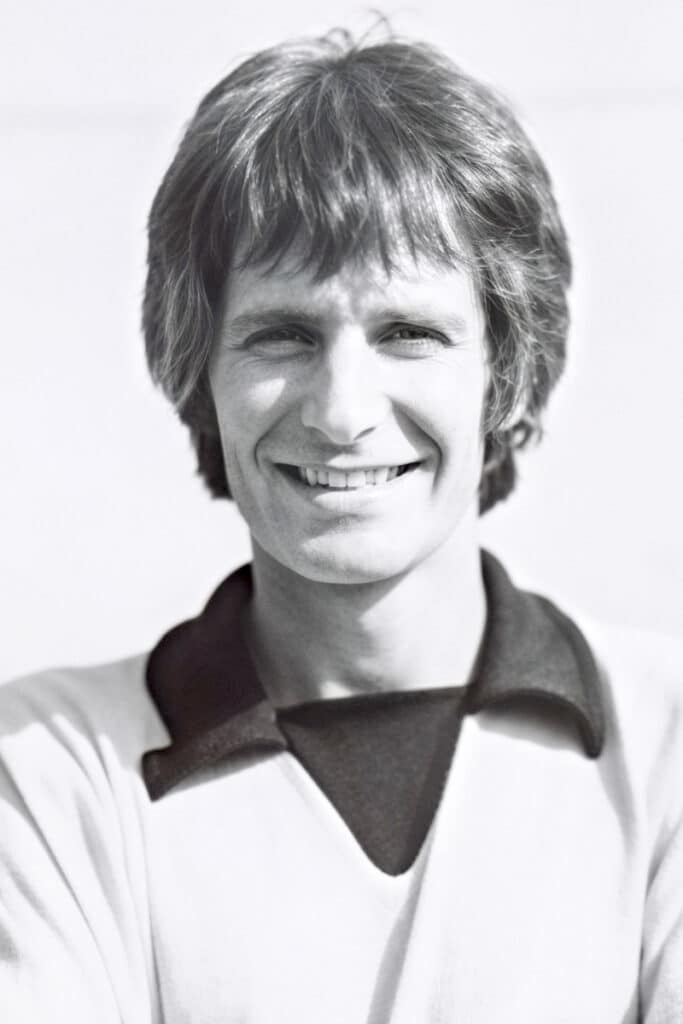
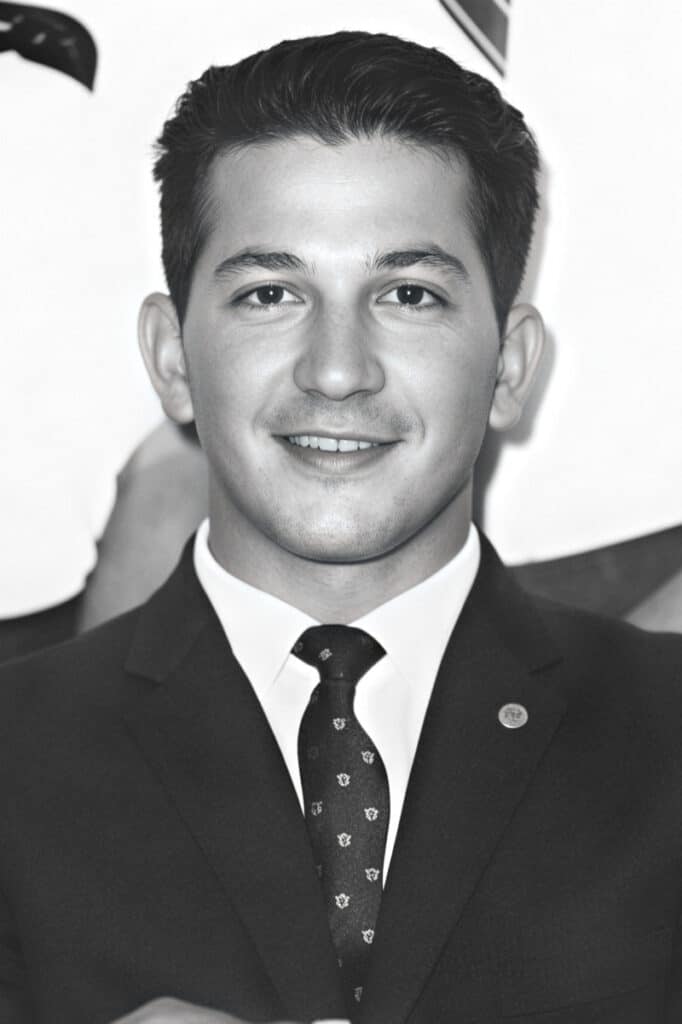
Re understandably wanted the matter resolved quickly. Within 24 hours, telegrams had been despatched by the Federation president to O’Connell and Paap, summonsing them to appear before a special meeting of the Federation council on the evening of December 2.
The inquiry, chaired by Federation vice president David Indermaur, heard the allegations of all parties. O’Connell and Paap were highly critical of Re’s handling the team. Re claimed O’Connell had broken team rules and was absent from his hotel room the night before WA’s match against South Vietnam.
The first set of accusations considered were those levelled at Re, who denied any wrong doing. With his defence centring around ensuring the safety of Western Australia’s players while in Malaysia, the inquiry found the Federation president had no case to answer to.
Six charges were laid against O’Connell, who pleaded guilty to one, of misconduct. For that he received one of the harshest punishments handed down to a player – a five-year ban from representing Western Australia and suspension from club football for 12 playing dates. The five other charges were defended by O’Connell and dismissed by the inquiry.
The charge against Paap – that he had embarrassed soccer in WA and publicly ridiculed a Federation officer – was not considered as he was holidaying on Rottnest Island with his family at the time. Given the inquiry began on a Tuesday evening and didn’t wrap up until the following morning, it was perhaps fortunate that Papp was unable to attend.
Perth’s tightknit football community were stunned by the length of the suspensions imposed on O’Connell when they were made public in the West Australia on December 4. Asked for comment, the former State team captain chose to remain silent while he considered his next action.
O’Connell made his move a week later by demanding his suspensions be quashed. Windmills officials had reviewed the Federation Constitution and found complaints against the Federation, a club member or player required posting at least seven days before the date of the hearing. O’Connell had been given barely 24 hours notice.
It wouldn’t be until the first week of January, 1970, that the matter came before the Appeals Board. The suspension of 12 club playing dates imposed on O’Connell was overturned, however, the State team ban would stand. The decision to lift the club portion of the penalty followed the hearing of an appeal lodged by Windmills.
On the same night, a meeting of the Federation council dismissed the charge against Paap. Infuriated by the rulings, Re resigned as president effectively immediately. “I cannot understand the thinking of the appeals board in the O’Connell case, or the action of the council in dismissing the charges against Paap,” Re told the West Australian.
“The Paap case is an example of a player getting away scot free after having publicly criticised a leading soccer official. Unless players are disciplined for this type of conduct it will become a common occurrence. It is an open invitation for players to do what they like.”
“I have recently been criticised by several council members. Since they are apparently so unhappy with me, then it is better that I sever my connections with the game. I only hope that somebody can be found who is willing to spend as much time on soccer as I have done.”
The saga took another dramatic turn a week later when Re was returned to the position of Federation president. Although the council has accepted his resignation, it was declared unacceptable on constitutional grounds at a meeting of club secretary’s, the majority of who backed Re.
“More than 20 of the 26 clubs present last night voted that I continue to serve out my existing two-year term as president and it was gratifying to find I had such strong support. I felt there was an obligation to fulfil,” Re is quoted as telling the West Australian of January 14.
Later that week O’Connell and Paap took to the field in Windmills opening game of the Night Series. O’Connell, who would soon be appointed coach of Windmills, marked the occasion by heading in a Cees Scheepens cross for his teams second goal in a thrilling 2-2 draw with Olympic.
It would be a trying winter for Windmills, who eventually rose to fourth on the league ladder after being in the mix for relegation at the season mid-point. O’Connell was praised for turning their season around but it was Paap that was the real hero, the classy defender collecting a record fourth Carbonell Cup as the league’s best player.
Re’s 10-year reign as Federation president came to an end in December 1971 when John Venn took office. Six months later O’Connell’s suspension was reviewed and his ban from representing Western Australia lifted. His return to State team duty arrived in June 1972 against touring English First Division club Wolverhampton Wanderers.